
TÜBİTAK 121 Y 570 – COST 2519 Project
Investigation of Circular Water Management Opportunities on Multisectoral (Urban, Industry, and Agriculture) Scale: Küçük Menderes River Basin Case Study
What is Circularity ? What does the circular economy mean?
Designing and promoting items that last and can be reused, repaired, and remanufactured are key components of a circular economy. The circular economy is a systems solution framework that tackles global challenges like climate change, biodiversity loss, waste, and pollution (https://ellenmacarthurfoundation.org/)
What do nature-based solutions (NbS) mean?
Nature-based Solutions (NbS) are defined by IUCN as “actions to protect, sustainably manage, and restore natural or modified ecosystems, that address societal challenges effectively and adaptively, simultaneously providing human well-being and biodiversity benefits” (iucn.org)
Short Information About COST Actions
Each COST Action is a network around nationally-funded research projects of interest in at least 5 COST countries. COST funds the joint activities of COST Actions such as conferences, short-term scientific exchanges, and publications.
Please visit the website to obtain more information: www.cost.eu
The COST ACTION CA 17133
The aim of the COST Action “Circular City Re.Solution” is to build an interdisciplinary platform for connecting city planners, architects, system designers, circular economists, engineers, and researchers from social and natural sciences that develop systems allowing cities to cope with the challenges described above. In this COST Action, the definition of a common language and understanding across disciplines are seen as a crucial success factor, while CE concepts are seen as a key approach and NBS or GI solutions are seen as core elements of the toolbox. This Cost Action is to encourage collaboration and research to test the hypothesis that “A circular flow system that implements NBS for managing nutrients and resources within the urban biosphere will lead to a resilient, sustainable and healthy urban environment”. The planned Action will test this hypothesis in five domains: the built environment, the urban water, the resource recovery, the urban farming, and the society.
The official website of the CA 17133: https://circular-city.eu/?page_id=70
The information about the Project 121 Y 570
The proposed project has been prepared by the content and scope of the 2nd Working Group working on “Sustainable Urban Water Management”, which is included in the COST ACTION named “Circular City (CA17133)”.
The proposed project aims to develop circular water management opportunities and thus efficient water use among urban, industrial, and agricultural water users in the Kücük Menderes River Sub-Basin.
The project consists of three main stages:
- Current Situation Analysis stage: The characterization of the basin will be revealed, NBS potential will be investigated, and water use and urban/industrial wastewater profile will be determined. The data obtained from these studies will lay the inventory groundwork for the development of circular water management opportunities considering the axis of city-industry-agriculture, by revealing the characteristics of the basin, water use, and users.
- Performance Evaluation and Suggestion Development stage: Water efficiency and circularity key performance indicators (KPI) will be defined, and circularity analysis of water-intensive users will be carried out. Circular water system suggestions will be developed and, their effects will be evaluated.
- Method/Procedure Development stage: The circular water management framework will be developed to make the studies specific to the Küçük Menderes River Sub-Basin applicable in other basins, and it will be ensured to be repeated in different users or regions, so the outputs of this project will gain a sustainable dimension.
The unique value of the presented project proposal is that it brings a different and new scientific approach to water management, emphasizing circularity instead of the usual linear water use approaches on the axis of city-industry-agriculture. For this purpose, it is predicted that a unique theoretical and methodological solution can be developed to reduce water constraint problems in basins by integrating water footprint, pinch analysis, and nature-based solutions (NBS) approaches into the management model in an integrated manner. Other innovative features of the project are considering the green and gray water footprint; linking NBS with circular water management; bringing the different users together on the city-industry-agriculture axis through pinch analysis.
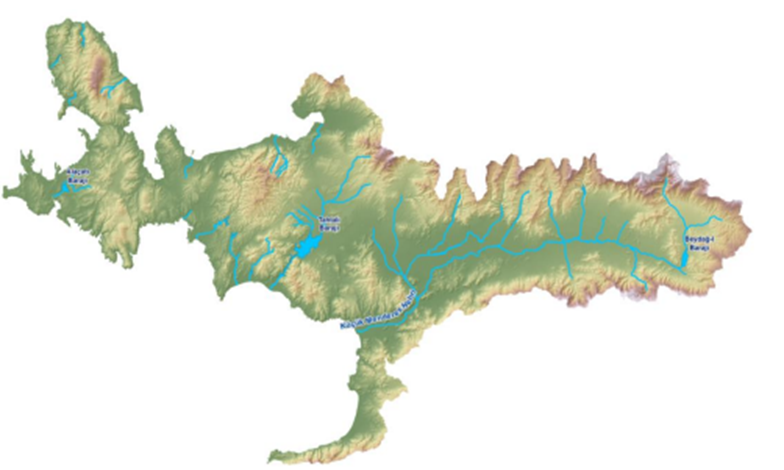
Source:
121 Y 570 The Project Team
Project Manager :
İngilizce İnşaat Mühendisliği Bölümü
https://scholar.google.com.tr/citations?user=oRxyCHYAAAAJ&hl=tr
Researchers:
Çevre Mühendisliği Bölümü
https://scholar.google.com.tr/citations?user=fTlWk5IAAAAJ&hl=tr
Çevre Mühendisliği Bölümü
https://scholar.google.com.tr/citations?user=heJLEMIAAAAJ&hl=tr
https://gte.com.tr/ekip/dr-emrah-alkaya/
https://tr.linkedin.com/in/ahmet-avni-atayol-77b9b065
Project Graduate Student:
Çevre Mühendisliği Bölümü
https://tr.linkedin.com/in/thomas-bladen-07702b231
TÜBİTAK STAR Bursiyeri
Çevre Mühendisliği Bölümü
https://www.linkedin.com/in/selencaglaunal/
Çevre Mühendisliği Bölümü
https://www.linkedin.com/in/belfu-bayirtepe-914177176/
Proje Consultants:
İleri Araştırmalar Merkezi
https://hasansaygin.com/tr/ozgecmis/
Çevre Mühendisliği Bölümü
https://debis.deu.edu.tr/akademiktr/index.php?cat=3&akod=19912509
Contact:
Volkan ORAL